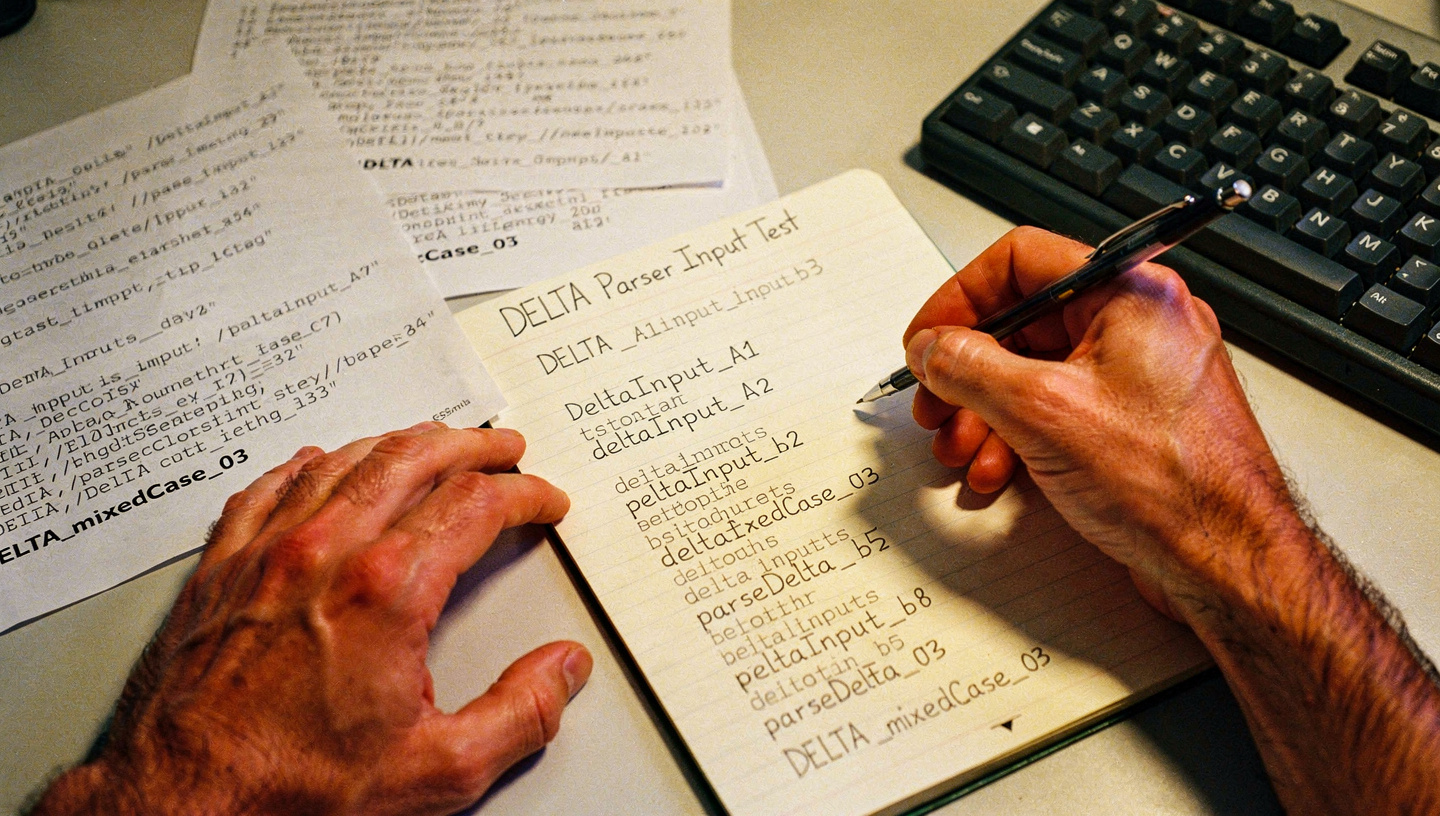
The Nightmare (Real Life): A text-processing component appears reliable until mixed-case input reaches a case-sensitive boundary. A reviewer sees the expected words and assumes the payload survived, even though escaping, transport encoding, or manual normalization changed it. The test report says the pipeline passed because the final text looked close enough. The Alternating Case Converter can create a deterministic mixed-case probe from the DELTA seed, but a professional workflow must escape, encode, decode, and compare that probe without silently correcting it.
🚨 The 3 Fatal Mistakes (Mıstrakes) You're Probably Making
- Mistake 1: Using Random Input Without a Reproducible Seed Label - A failure that cannot be recreated is expensive to diagnose. DELTA provides a recognizable starting point, while the transformation steps define the actual test case.
- Mistake 2: Normalizing Case Before Comparison - Lowercasing both values can hide defects in case-sensitive fields, signatures, paths, identifiers, or parser behavior.
- Mistake 3: Confusing Encoding with Encryption - Base64 changes representation for transport. It provides no confidentiality, integrity guarantee, or authorization boundary.
💡 The Master's Workflow (Pro-Pattern)
The senior pattern is to construct one deterministic probe and preserve evidence at every boundary. Start with a documented DELTA phrase, transform it with the Alternating Case Converter, escape it for the intended string context, encode it for transport, decode it, unescape it, and compare the recovered value with the transformed source. Each intermediate value becomes an observable checkpoint. The pipeline succeeds only when the final comparison is exact and every transformation is justified by the receiving context.
🛠️ The Arsenal: Step-by-Step Tool Chain
Begin with an exact, documented phrase containing the DELTA seed, ordinary words, spaces, punctuation, and any line boundaries relevant to the parser. Preserve that source separately. Convert the phrase with Alternating Case Converter and record the result as the expected mixed-case value. Do not assume which character receives uppercase first; the recorded output is the authority for this test. Avoid inserting actual secrets, credentials, or sensitive operational data.
Escape the mixed-case value according to the string context under test. The purpose is not to add decorative backslashes but to preserve delimiters, quotes, control characters, and line boundaries when the value is embedded. Record the escaped result as a separate checkpoint. If the target context does not require escaping, document that decision instead of adding an unnecessary transformation.
Encode the escaped value with Base64 Encoder. This creates a representation that can move through text-oriented boundaries without exposing the original punctuation directly to those boundaries. Record the encoded output exactly, including padding when present. Do not call this encrypted or secure. Base64 is representation, and treating it as protection is a serious design error.
At the receiving checkpoint, decode the Base64 value and compare the result with the recorded escaped value. If they differ, stop. Do not continue and hope the unescaping step repairs the payload. A staged test should fail at the first violated boundary because later transformations can obscure the original defect.
Unescape the decoded value to recover the candidate mixed-case probe. Then use Text Diff Checker to compare that candidate with the output recorded after the Alternating Case Converter step. Inspect case, punctuation, whitespace, and line endings. Although Text Diff Checker is the verification instrument, the five-stage chain remains centered on creation, escaping, transport encoding, decoding, and restoration. A pass requires exact agreement under the test's documented text rules.

🧠 Senior Tips (Usta Notları)
🔥 Compare at every semantic boundary
A final mismatch tells you that something failed. Intermediate checkpoints tell you where it failed.
🔥 Never repair the test value by hand
Manual casing or escape corrections erase the evidence the test was designed to capture.
❓ 5 Critical Questions Answered (FAQ)
Q1Why is alternating case useful for parser tests?
Q2Is DELTA a source of randomness here?
Q3Why escape before Base64 encoding?
Q4Can Base64 protect sensitive test values?
Q5What counts as a passing result?
🔗 Share / Save
Save the DELTA source, every intermediate value, and the exact comparison result together. A parser test without reproducible checkpoints is theater; this chain turns it into evidence.